Agro-ecosystems Research
Field experimentation and biophysical simulation modeling to understand environments for improved rice production

L.T. “Ted” Wilson, Ph.D.
Professor and Jack B. Wendt Endowed Chair in Rice Research
Understanding environments for improved rice production
The Agro-ecosystems program uses both field experimentation and biophysical simulation modeling. A selection from aspects of this work are:
- Effects of key primary phenotypic traits on genotype (cultivars and elite lines) performance.
- Advanced phenotyping combined with process-based crop modeling to identify which traits have the largest impact on yield and quality performance.
- QTLs and major genes associated with key phenotypic traits responsible for grain yield and quality performance.
- Effects of major climatic drivers on crop yield and grain quality.
- Effects of major biotic stressors on crop yield and quality performance.
- Optimizing post-harvest insect pest management.
- Determining optimal locations for the establishment of a cellulosic bioenergy industry in Texas and in the Gulf Coast region of the U.S.
All research is team efforts, with many involving Omar Samonte, Yubin Yang, Shyamal Talukder, and collaborations with scientists from a wide range of U.S. organizations and countries, which provides considerable benefit to U.S. agriculture.
Effects of key primary phenotypic traits on genotype (cultivars and elite lines) performance
- For several rice genotypes detailed dynamics of light interception, photosynthesis, and respiration were measured every minute of each day and night for several days
- Detailed estimates for potential growth rates and allocation priorities for different organ and age classes
- The capture of light, which is based to a cultivar’s light extension coefficient, varies greatly by time of day and across cultivars
- The ability of each cultivar to generate sugars and carbohydrates from varies greatly and is largely a function of the degree with which photosynthesis feedback inhibition constrains photosynthesis for each genotype.


Advanced phenotyping combined with process-based crop modeling to identify which traits have the largest impact on yield and quality performance
- Over 30 primary phenotypic traits have been identified of which 8 account for nearly 80% of the yield variability across rice genotypes
- Several genotypes have been grown whose combination of primary traits suggest they should be superior yielders
- Field growth studies and simulation analysis has both shown that about 87% of these genotypes are high yielding because on their complement of underlying phenotypic traits that govern crop growth, development, maturation, and yield

QTLs and major genes associated with key phenotypic traits responsible for grain yield and quality performance
- Advanced phenotyping use to identify which traits have the largest impact on plant height, days to maturity, grain yield and several grain quality traits
- High density sequencing (21x) to determine identify which genes control the expression of key phenotypic traits necessary for the development of high yielding superior quality cultivars

Over 3,000 sets of crosses using cytoplasmic male sterile (CMS) and thermogenic male sterile lines and fertility restoring male lines, have been produced by our team (Wilson, Yan, and Samonte (unpublished data). Some parental lines have high breeding values as indicated by vertical green lines (for males) and horizontal green lines (for females).
High density sequencing has been conducted for approximately 200 of the parental lines used to create the crosses. Analyses are underway.
Effects of major climatic drivers on crop yield and quality performance
- The higher the heat accumulated during daytime hours > 86˚F, the higher the grain yield and head rice yield.
- The higher the heat accumulated above 86˚F during the day and higher the total heat accumulated during the night, the lower the grain yield and head rice yield.
- Temperature > 86˚F reduce photosynthesis, while high nighttime temperature cause the rice plants to “burn” more calories respiring
For each day after the harvest day of year that produces the highest yield, grain yield decreases on average 33.9 lb/ac/day as shown in Figure 1 for inbred rice. At $17.50/cwt that’s a cost of $5.93/ac/day delay.
Comparing fields that have an April 15 seeding date to those that have a March 15 seeding date, the April 15 seeding date fields will on average have a yield penalty of $183.91/ac. A very similar pattern is observed for hybrids, but with the hybrid yield response curve shifted higher. The bottom line, regardless of the rice variety, planting in early- to mid-March on average makes growers more money.

Effects of major biotic stressors on crop yield and quality performance
- Determining the economic threshold for the sugarcane borer on rice
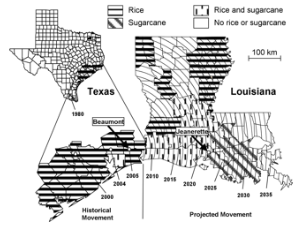
- Determine the role of alternative plant hosts on the regional spread of the sugarcane borer on rice
- Estimate the rate of spread and economic impact of the Mexican rice borer on rice
Research on both the sugarcane borer and the Mexican rice borer was conducted with Gene Reagan (LSU), Francis Reay Jones as post-doc, Jiale Lv and Julien Beuzelin as graduate students, and Mo Way (Texas A&M).


Optimizing post-harvest insect pest management
- To develop an integrated aeration and insect pest modeling system
- To determine the potential of aeration to control grain pests in storage facilities
A significant component of this research has focused on estimating the effects of post-harvest aeration management on the population dynamics of grain feeding pests that can build-up to damaging levels in grain bins and elevators. Our research in this area show that the potential for damaging populations to develop increases closer the storage is to the Gulf Coast.
The research also shows that the need to control injurious post-harvest insects with pesticides can be reduced by circulating cooler air from outside of the bins during the nighttime, which lowers the temperature and reduces the rate of pest population increase.

Determining optimal locations for the establishment of a cellulosic bioenergy industry in Texas and in the Gulf Coast region of the U.S.
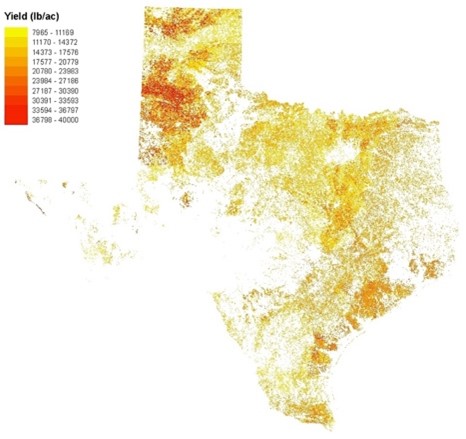
- Dynamically simulate the yield and economic returns of each conventional crop, energycane, and biomass sorghum for each field in Texas and in the southeast U.S.
- Compare the simulated revenue for each food, feed, fiber and putative bioenergy crop growth in the southeast U.S.
- Determine which sites provide the greater potential for economic return for biomass sorghum and energycane.
The most important determinates of whether energycane or biomass sorghum becomes commercially viable are the price of conventionally and cellulosic produced oil, government price incentives for production, and the yield potential of energycane and biomass sorghum production. Biomass sorghum is much better suited across a wider geographic range.
However, energycane produces much higher yields along the Gulf Coast where plentiful rainfall and relatively heavier soils are more favorable for its production.
This research is jointly conducted with Dr. Yubin Yang and Jenny Wang.