

Plant Physiology
Research to improve regional crop plants and their production systems
Dual obligations to crop plant physiology
Through discovery and application of knowledge of the physiology of crop plants, our research in plant physiology positively impacts the economics and sustainability of crop production locally and globally.
As plant physiologists working with crops, researchers at the Texas A&M AgriLife Research and Extension Center at Beaumont have dual, interdependent, obligations
Discovering and applying knowledge of how the crop plant and plant populations function and interact with the environment for the agronomic and genetic improvement of crop production at all scales – global to regional, and


‘Troubleshooting’ and improving specific production systems in the region (rice is the major crop where we are located) as part of an interdisciplinary team.
Faculty

Lee Tarpley, Ph.D.
Professor, Plant Physiology


Three Research Objectives of the Plant Physiology Program
1
Discover knowledge of plant physiological processes pivotal to how a crop plant operates in producing the product of yield.
2
Develop near-term strategies to directly improve crop productivity/profitability.
3
Develop strategies for measuring novel characteristics that can be used to assist crop genetic improvement.
An Experimental Research Approach
Rice plant responses to regional stresses
One of our main research interests is understanding how rice plants respond to the important environmental stresses in the growing region along the U.S. Gulf coast, such as high night temperature and ultraviolet radiation, and making suggestions to improve crop management and genetic improvement to reduce the environmental stress impacts. This research requires developing methods to appropriately expose plants or plant populations to future environmental stress conditions. For example, our project developed instrumentation for Free Air Temperature Enrichment of plants for high night temperature stress studies that is adequate for plant physiology studies
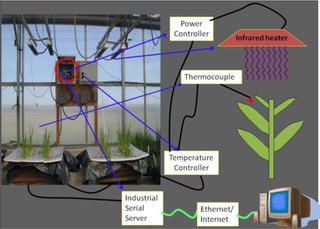
Technology development
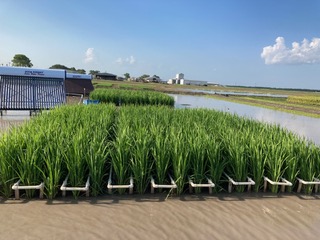
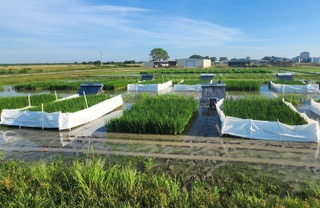
We are developing field equipment for exposing breeding populations to high night temperature stress. The system solar-heats water during the day and collects it in a tank, then radiates through the plots during the night under control.
When examining plant physiological response to an environmental stress, we often include a plant growth regulator providing potential physiological response against the environmental stress. This (1) can help pinpoint the mechanism of the plant stress response, if effective, and so suggest targets for genetic improvement of tolerance, and (2) provides a potential tool for crop management of the environmental stress.
Regional rice crop profitability
Our research aims to improve the profitability of rice crop production along the U.S. Gulf coast by applying plant physiology knowledge. The approach is to use plant growth regulators to either minimize stress effects on the crop or to manipulate the growth or development of the crop. A requirement is that the plant growth regulator should be a good tank-mix partner with to save on application costs.
Here are a few examples of plant growth regulator applications developed by the Plant Physiology Project with the intent to help rice producer profitability:
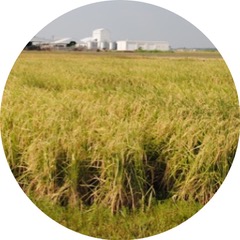
Gibberellic Acid
Gibberellic Acid (GA), such as RyzUpTM at main crop soft dough to improve ratoon crop yield. A GA application of 4 grams (0.009 pounds) a.i. per acre from several days post flowering to soft dough of the main crop can increase ratoon yield of the very early maturing hybrids by an average of 622 pounds per acre by enhancing early ratoon tiller growth and ratoon stand establishment.
Plant growth retardant
Plant growth retardant, such as Palisade (Syngenta), applied 14 days post panicle differentiation at the rate of 0.075 pounds a.i. per acre to early maturing hybrids growing on heavy-clay soils can help reduce the risk of lodging and allow the use of higher amounts of nitrogen fertilizer (e.g., 200 pounds per acre to the main crop) resulting in increased main crop yields of about 800 pounds per acre. Note that Palisade is no longer labeled for rice.
cytokinin-containing plant-growth regulator
A cytokinin-containing plant-growth regulator, Onward MaxTM, when applied at panicle differentiation at 16 fluid ounces per acre (or at any labeled rate) improved yield more than 500 pounds per acre, and profitability by $59 per acre, by modestly increasing several plant physiology ‘health’ indicators.
